Beyond the Org: Why Salesforce-Only Architects Struggle in the Enterprise
Every organization has a different definition of what an architect does, and a Salesforce solution architect is undoubtedly a key figure in large projects. But when we talk about the role of an in-house enterprise architect, a hard truth is emerging.
In most companies, excepting the ones whose architecture lives entirely on the Salesforce landscape, there is very little value in an enterprise architect who only understands Salesforce.
Yet, I have worked with a number of Salesforce architects who have never bothered to learn enterprise patterns that live outside of the Salesforce ecosystem. In the era of headless platforms and distributed AI orchestration, this platform-locked mindset is a fast track to obsolescence.
To remain relevant, a modern architect must look past the boundaries of the CRM sandbox.
1. The Trap of the Closed Ecosystem (Platform Lock-in)
We do ourselves a disservice as a community by locking into Salesforce-specific products and assuming their simplified abstractions represent industry standards.
Take event-driven architecture (EDA) as a primary example. You could easily lull yourself into a sense of thinking you know how it works because you know how to design a system based on Salesforce Platform Events. But then you will walk into an enterprise integration meeting and find yourself unable to articulate how retry mechanisms and fallovers are supposed to work in the broader infrastructure.
Because Salesforce Platform Events are so basic, they lack fundamental enterprise messaging concepts:
- Dead Letter Queues (DLQs): There is no native concept of isolating poisoned messages that repeatedly fail processing so the rest of the queue can continue.
- Granular Retry Policies: You cannot easily configure backpressure or exponential backoff limits natively.
- Failover Topologies: Active-passive routing and message replication strategies are hidden behind the platform curtain.
If you only designing with Salesforce Platform Events capability in mind, you aren't designing a resilient enterprise event-driven architecture; you are just configuring a proprietary pub/sub channel.
2. Networking and Observability: The Big Blind Spots
Two areas where Salesforce-only architects consistently struggle are networking and centralized observability.
The Networking Gap
Networking is a notorious weak spot. Because we historically never have to worry about the underlying infrastructure in a SaaS environment, Salesforce architects often struggle when integrating with secure, highly regulated on-premise or private cloud environments.
When security engineers ask how we plan to secure traffic between Salesforce and their internal databases, responses like "Isn't there an API?" or "Can you just allow list our Salesforce login IP ranges?" cause enterprise infrastructure teams to roll their eyes.
A modern architect must understand few important key concept related to non SaaS/SaaS platform which customer owns:
- Virtual Private Clouds (VPCs): How resources are isolated in AWS, GCP, or Azure.
- Private Link & Transit Gateways: How to establish secure, private, non-public internet tunnels (like Salesforce Private Connect) instead of exposing endpoints to the public web.
- IP Allowlisting Limits: Why static IP allowlists are a fragile security mechanism in dynamic, auto-scaling cloud environments.
The Observability Gap
Similarly, enterprise systems do not live in a single log console. At a minimum today, you should be confident in articulating centralized observability and resilience patterns.
The number of Salesforce architects who cannot coherently talk to engineering teams working on even a simple microservice like an AWS Lambda function,is frustrating. If an integration fails, you cannot rely on looking at a Salesforce ApexLog record. You must know how to design distributed tracing patterns (e.g., passing correlation IDs) so that a transaction can be traced from a React frontend, through AWS API Gateway and Lambda, down into Salesforce, and out to a Datadog or Splunk dashboard.
3. The Headless Salesforce Shift
The rise of Headless Salesforce architectures has accelerated the need for broader architectural skills.
More organizations will start using Salesforce as a secure backend database, transactional engine, and metadata hub, while building custom, high-performance customer portals or internal interfaces using modern frameworks like React, Next.js, or Vue.
In this model, the boundaries of the system shift:
- UI Isolation: The presentation layer is completely decoupled from the Salesforce runtime, running on edge networks like Vercel or Netlify.
- API-First Design: Communication occurs over high-speed REST, GraphQL, or Pub/Sub APIs.
- State & Caching: Session state and API responses must be cached at the edge (using Redis or CDN layers) to avoid hitting Salesforce concurrent request limits.
As a Headless Architect, you are no longer configuring page layouts or record types; you are designing API contracts, token exchange security patterns, and data synchronization flows across multi-cloud infrastructure.
4. AI Orchestration and Agentic Boundaries
The introduction of autonomous AI agents (such as Agentforce or custom LangGraph/Python agents) pushes the boundaries of Salesforce even further.
When building agentic workflows, Salesforce is simply one node in a larger intelligence network. An AI agent might start its reasoning loop in Salesforce, call an external LLM hosted on Bedrock or OpenAI, query an external Vector Database (like Pinecone) for context, and run a Python script in a sandboxed AWS Lambda environment to parse a document.
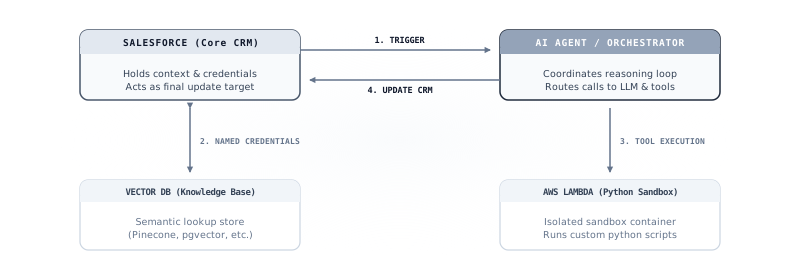
An architect who only knows how to write Apex triggers or build Salesforce Flows will fail to design this safely. You must know how to govern this orchestration:
- Secure Agent Callouts: Managing OAuth scopes and Named Credentials so the agent doesn't leak credentials.
- Token Management & Rate Limits: Controlling costs and preventing LLM API rate limits from shutting down business processes.
- Audit Trails: Logging agent steps and tool outputs securely outside of standard session memory for compliance audits.
The Path Forward
Salesforce is a highly capable and powerful piece of the enterprise puzzle. But its core abstractions are different enough from standard software engineering that as you grow, you must actively try out other technologies—even if you want to stay purely technical.
 We do ourselves a disservice when we limit our learning to the next release notes or certification track.
Learn how Docker works. Deploy a simple FastAPI service to AWS Lambda. Configure an event queue in RabbitMQ or AWS SQS and set up a dead letter queue. Understand how CORS and VPC routing work.
Step outside the Salesforce ecosystem. It won't make you less of a Salesforce architect—it will finally make you an enterprise one.